White House Highlights HHI’s Role in Improving Health, Lowering Costs

The White House Council on Environmental Quality (CEQ) yesterday hosted the Healthier Hospitals Initiative (HHI) for a discussion celebrating the health care industry’s innovative success in adopting more sustainable practices. The event, “Greening America’s Hospitals,” specifically highlighted HHI’s successful efforts to reduce the environmental footprint of hospitals, lower costs and improve patient health by incorporating environmental sustainability initiatives into their business models.

In addition to HHI and CEQ, senior Administration officials, hospital administrators, business leaders and policy experts lent their perspectives to the discussion. The discussion included two panels, “Fostering a Culture of Environmental Sustainability” and “Healthier Hospitals Initiative: Transforming the Supply Chain.” The panelists included:

  • Gary Cohen, President, Health Care Without Harm, and Founder of the Healthier Hospitals Initiative
  • Kathy Gerwig, Vice President, Workplace Safety and Environmental Stewardship Officer, Kaiser Permanente
  • Al Iannuzzi, Senior Director Product Stewardship, Worldwide Environment, Health and Safety at Johnson & Johnson
  • John Messervy, AIA, Director of Capital and Facilities Planning, Partners HealthCare
  • Brad Perkins, MD, Executive Vice President for Strategy & Innovation, & Chief Transformation Officer, Vanguard Health Systems
  • Blair Sadler, Senior Fellow, Institute for Healthcare Improvement; former CEO of Rady Children’s Hospital
  • J. Knox Singleton, CEO, Inova Health System
  • Jeff Thompson, MD, CEO, Gundersen Health System
  • Christina Vernon, Executive Sustainability Officer, Cleveland Clinic
  • Seema Wadhwa, Director, Healthier Hospitals Initiative

Several senior officials of the Obama Administration were on hand to spotlight HHI’s effective approaches to implementing sustainability initiatives that reduce costs and improve patient care in health care facilities across the country. Officials included:

  • Heather Zichal, Deputy Assistant to the President for Energy and Climate Change
  • Maria Vargas, Director of the Department of Energy’s Better Buildings Initiative
  • Bicky Corman, Deputy Associate Administrator for the Environmental Protection Agency’s Office of Policy
  • Nancy Sutley, Chair of the White House Council on Environmental Quality
  • Jon Carson, Director of the White House Office of Public Engagement

For more information about HHI’s efforts, read Gary Cohen’s blog post, “Promoting Sustainable Health Care,” on the White House’s website.

A recording of the event is available on the White House’s YouTube channel.

Healthcare leaders discuss greening the supply chain, lowering costs

Source: Healthcare Finance News

WASHINGTON – During a White House Council on Environmental Quality (CEQ) conversation on Tuesday, leaders in healthcare and policy discussed the Healthier Hospitals Initiative (HHI) to reduce the environmental footprint of hospitals, lower costs and improve overall patient health by including sustainability efforts and initiatives into their business models.

The Healthier Hospitals Initiative (HHI) is a national campaign to implement a new approach to improving environmental health and sustainability in the healthcare sector. Eleven of the largest U.S. health systems, comprising approximately 500 hospitals with more than $20 billion in purchasing power, worked with Health Care Without Harm (HCWH), the Center for Health Design and Practice Greenhealth to create HHI as a guide for hospitals to improve sustainability.

Among those at Tuesday’s forum, “Greening America’s Hospitals: A White House Discussion on the Healthcare Industry,” were representatives from nationwide healthcare group purchasing organizations (GPOs). They discussed the critical role of the healthcare supply chain in introducing these environmentally sustainable designs.

“I thought it was very productive discussion, and it’s true that the supply chain is an important part of greening the healthcare system,” said Healthcare Supply Chain Association (HSCA) President Curtis Rooney. “What people choose to buy matters and if you can get green products you can really move the market.”

Rooney noted that last year HSCA endorsed the Practice Greenhealth “Standardized Environmental Questions for Medical Products,” which has been used to guide the identification, selection and procurement of environmentally preferable medical products. The tool is a significant part of Practice Greenhealth’s “Greening the Supply Chain Initiative,” which the organization launched in 2011 to provide a common set of tools for purchasers, suppliers and manufacturers to ensure that environmentally preferable products are available, cost competitive and of comparable quality.

“It’s primarily important to make sure the patient gets the right and safest product, but this initiative can also save money by aggravating the purchasing. It creates the ability for the prices to be driven down so that these environmentally preferred products can be affordable,” Rooney said.

Jennifer Waddell, senior clinical manager at Novation, a healthcare supply chain expertise and contracting company, said Tuesday’s discussion “brought to life an issue that is very important.”

“We support legislation around full disclosure of products in technology and using non-toxic products in medical devices,” she said. “We also have to do this in a cost effective manner. A lot of people think environmentally friendly products tend to be more expensive, but with a lot of the products in the medical device market there ends up actually being a savings when you move to some of these measures. Also, energy conservation helps hospitals save money in the long run.”

Food trucks give sustainability green light

Source: National Restaurant Association

Food trucks, currently one of the most popular segments in foodservice, are driving an effort to be more eco-friendly, industry watchers are saying.

It’s not that this emerging segment is “greener” than market sectors populated by brick-and-mortar restaurants per se, observers agree. Because the trucks are proliferating so rapidly, they’re increasing the number of foodservice places that can engineer sustainability into the operation from the ground up.

Or, in the case of rolling feeders, such as southern California’s Green Truck or New York City’s Snap Food Truck, from the tires up.

Hudson Riehle, senior vice president of the National Restaurant Association’s Research & Knowledge Group, said the rollout of sustainable food trucks is “a developing trend that overlays the mobile sector as well as conventional restaurants.”

He further noted that food truck operators enjoy great confidence that their customers, who tend to be of a younger demographic, value their sustainability efforts.
Continue reading Food trucks give sustainability green light

White House Asks Businesses to Identify Burdensome Regulations

On July 18, 2012, The White House opened up its regulatory reform effort to the public, launching a website for tips on how the government can streamline or eliminate regulations.  In 2011 the President directed all executive agencies to undertake an unprecedented government-wide review of regulations on the books, in order to figure out what is working and what is not, and where appropriate, to streamline or eliminate ineffective, overly burdensome, and outdated rules. Over two dozen agencies responded with regulatory reform plans, listing more than 800 initiatives. The Administration is now asking for businesses to send them comments identifying burdensome regulations.

Toward More Sustainable Meetings

Source: Environmental Expert.com

Greener Meetings with New ASTM Standards

A collection of standards developed by Subcommittee E60.02 on Hospitality guides planners and suppliers on how to arrange more sustainable meetings.

It’s a meeting at an inn in Vermont designated as a “Green Hotel in the Green Mountain State” that, among other benchmarks, composts leaf and yard waste. It’s a corporate event by a firm that checks for needed products in the U.S. Environmental Protection Agency’s Environmentally Preferable Purchasing database. It’s a meeting arranged by a planner who considers a destination’s public transportation system and a venue’s recycling program. A green meeting may be any one of these things, and more.

Increasingly, greener — or more sustainable — meetings are occurring across the landscape. Today, more sustainable meetings, encouraged by EPA guidance on the topic and also available with the help of professional planners, mean more than what’s green. Sustainable meetings, in addition to the environment, consider social factors; they also make good business sense.

And now, through the work of ASTM International Committee E60 on Sustainability and its Subcommittee E60.02 on Hospitality, and the broad industry representation on the group, eight recently released standards, with one more coming soon, can assist planners and suppliers in producing more environmentally friendly meetings.

The Benefits of Meeting
Continue reading Toward More Sustainable Meetings

Chemical-Free Floor Care

Source: Environmental Leader.com

Floor care — specifically stripping and refinishing floors — poses many challenges for building administrators. First, it’s costly. This is due to the fact that it is typically both time- and labor-intensive. It is estimated that as much as 90 percent of the cost of floor care is attributable to labor costs, and as such it can be one of the most costly of cleaning tasks.

For sustainable facilities, stripping and refinishing floors can also cause the kinds of significant environmental impacts that administrators try to avoid. One of the biggest concerns is the actual chemical stripper that is used to remove old finish and soils from floors. Traditional floor stripping chemicals are among the most powerful — and potentially harmful — cleaning agents in existence.

According to the Washington State Department of Labor and Industries, conventional floor finish typically contains butoxyethanol, sodium hydroxide (also known as lye), and ethanolamine in varying degrees. All of these chemicals can be corrosive to eyes and skin and harmful if inhaled. Risks increase if they are used improperly or an accident occurs.
Continue reading Chemical-Free Floor Care

Lean Six Sigma gives employees a voice for changes

Source: Fierce Healthcare.com
Lean Six Sigma isn’t just good for the wallet; it’s good for morale, according to hospitals going through the process. While Lean Six Sigma advocates hail the strategy as cost-effective and efficient, other supporters also praise its effects on employee satisfaction and buy-in.

“It’s an avenue to have a voice and make change,” Brandee Hahn, a financial analyst and reimbursement manager at Good Samaritan Hospital in Vincennes, Ind., told Hospitals & Health Networks. Hahn is one of three people in the hospital’s Lean Six Sigma department, launched earlier this month.

Good Samaritan Hospital and Vincennes University collaborated to provide Lean training all 1,700 hospital employees, ranging from executive leaders to the cafeteria staff, to the yellow belt level, with others moving on to green and black belts, H&HN noted.

Hahn said she was worried it might just another flavor-of-the-month, but the additional training made it all real, suggesting a commitment from the hospital.

According to Chief Financial Officer Jerry Stump, patient safety, quality, patient satisfaction and financial performance goals using Lean Six Sigma are part of the organization’s strategic plan.

In another example, Rhode Island Hospital cited better employee morale and job satisfaction after implementing the Six Sigma methodology to improve the efficiency of frontline staff and streamline operating room patient flow, reduce workflow stress and eliminate waste, according to a study in the July AORN Journal from the Association of periOperative Registered Nurses.

“The implementation of the Six Sigma project at our hospital resulted in an improvement in the discharge process and ensured our ability to sustain a seamless surgical patient flow without incurring a financial cost,” the authors said in a statement.

Other literature suggests there is a link between Lean initiatives and staff involvement. According to the Agency for Healthcare Research and Quality, in the first independent comparative study of 13 Lean projects, staff at all levels reported higher employee satisfaction at every institution, citing better front-line staff involvement in problem-solving and employee collaboration.

For more information:
– read the H&HN column
– check out the AORN Journal study abstract
– here’s the AORN research announcement

Related Articles:
Lean management improves employee satisfaction
Lean model saves hospital system millions
Top-performing hospital credits Lean management with dramatic savings
The buzz around Lean Six Sigma at hospitals
Lean management: 3 ways to get docs on board

Where does your money go at the gas pump?

Source: Flex Fuel.com

Gas prices are slowly rising across the United States after months of a steadily declining, but who is really profiting off your gasoline purchases.

It might surprise you, but it isn’t the gas station.

An analysis of gas prices by Sageworks, a financial analysis company, shows that gas stations aren’t bringing in huge profit margins — or not the profits that consumers think.

For every $50 fuel purchase, gas station owners take home a measly $1, or a little more than 2 percent, according to the analysis by Sageworks. Visa or MasterCard make $1.25, or 2.5 percent, off every $50 gas purchase. (That’s why you see some gas stations in the Houston area offer you a discount for paying with cash.)

According to the research, crude oil accounts for 61.5 percent of the cost, or $30.75.

The rest of your money goes to refining crude oil into gasoline, $7 (14 percent); delivery $4 (8 percent); and taxes $6 (12 percent).

Gas Price breakdown

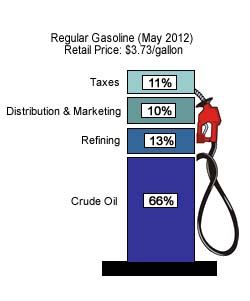
Gas price breakdown from Energy Information Administration


The U.S. Energy Information Administration puts out their own break down for gas prices, and their breakdown isn’t too far off Sageworks’ analysis.

According to the administration, a gallon of gas (at the July price of $3.42 per gallon) is broke down like this: taxes, 38 cents (11 percent, or $5.50 for a $50 purchase); distribution and marketing, 34 cents (10 percent, or $5); refining, 44 cents (13 percent, or $6.50); and crude oil $2.26 (66 percent, or $33).

Obviously, there are some slight differences between the two breakdowns, but they aren’t too far off.

So who do you blame for the high prices?